
Why Your Meta Ads Stopped Working in 2026 (It's Not What You Think)

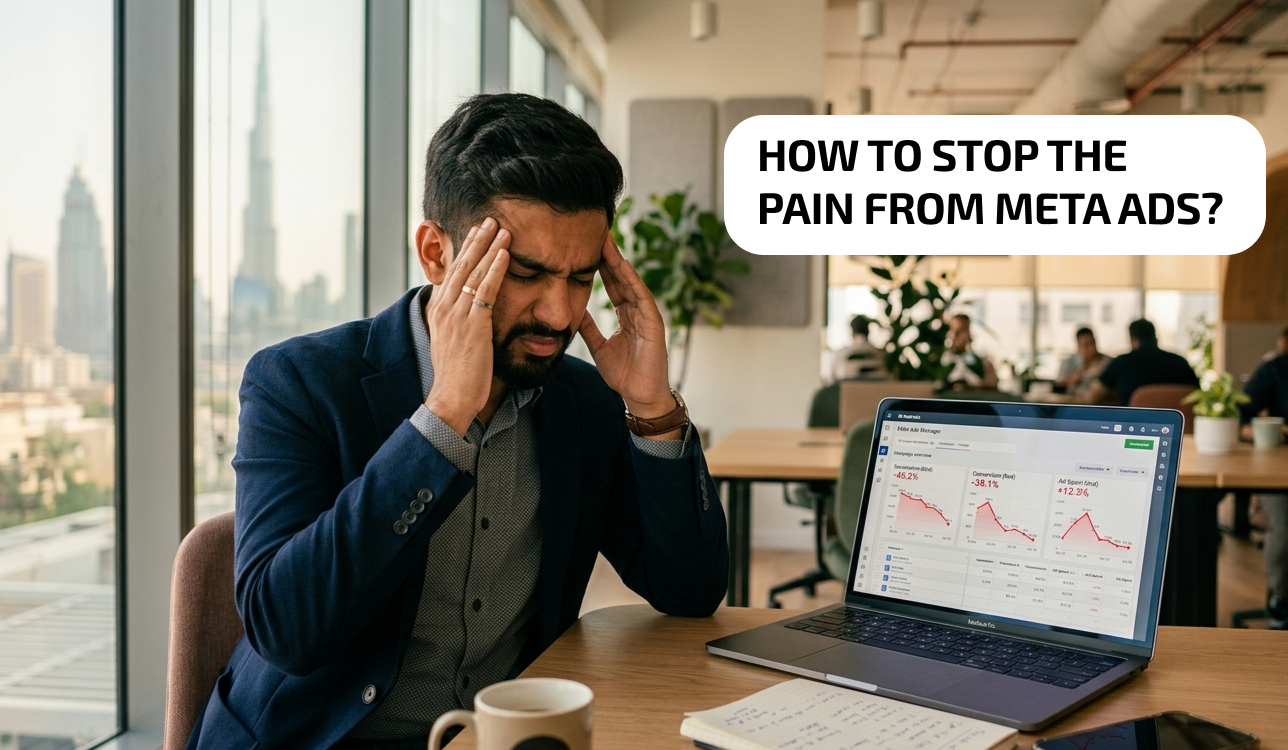
You spent weeks building your course. You recorded every lesson, polished every slide, wrote every word of your sales page. You launched it —and refreshed your inbox waiting for the first purchase notification.
Nothing happened.
Or maybe it did work, once. You had a launch that brought in students. But when you tried to replicate it —when you ran ads, boosted posts, or hired someone to "scale" your marketing —the money just... disappeared.
You're not imagining it.
Right now, 79% of course creators and coaches report burnout from trying to keep up with the content treadmill. Facebook organic reach has dropped to 2.6%. Instagram sits at 4% —and falling 18% year-over-year.
The posts that used to reach a quarter of your followers now reach less than one in twenty. And CPMs for education businesses are higher than they've ever been.
If your marketing feels like a casino —where you feed money in and occasionally, randomly, get something back —you're not alone. Thousands of course creators, coaches, and online educators across the region are describing the exact same thing:
"It has literally become a game of chance. One day is very good, the next day performance literally plummets."
"I keep tweaking, testing, optimizing like a maniac, but at some point, I just have to admit that we don't control this anymore."
This isn't a you problem. The game changed. And most people running ads in 2026 are still playing by the old rules.
What Actually Changed (And Why Nobody Told You)
Here's what actually happened.
In late 2025, Meta rolled out a fundamental change to how their ad system works. They called it Andromeda. Most advertisers never heard the name. They just felt the impact.
Before Andromeda, the playbook was straightforward: pick an audience, write an ad, set a budget, test a few creatives, and optimize based on data. It wasn't easy, but it was logical. You could study it, learn the system, and eventually make it work.
After Andromeda, the algorithm got significantly smarter —but also more sensitive. The old scaling playbooks that gurus taught for years —duplicating winning ad sets, running $25-$40/day budgets with 2-4 creatives, manually tweaking audiences —now actively break campaigns.
This is why your ads stopped working. Not because ads don't work anymore. Because the old way of running ads doesn't work anymore.
What specifically changed:
The algorithm now needs different signals. Different data. Different structure. It rewards accounts that feed it high volumes of creative variations —20-30 per week, not 3-5 per month. It punishes small, manually-managed campaigns. It wants consolidated structures, first-party data, and patience during learning phases that cost real money.
This created two realities. Large advertisers who adapted —who understood what the algorithm now wants —are scaling profitably. Everyone else is watching their costs climb while results disappear.
Every "Solution" Is Broken Too
And here's the part that makes it worse: every solution that used to work has been disrupted at the same time.
Boosting posts? That's paying to reach people who like and comment, not people who buy. It was never a real strategy —now it's an expensive illusion.
Organic content? With reach at 2-4%, you'd need to become a full-time content creator just to stay visible. Every coach is posting the same recycled content, hoping to stand out in an oversaturated feed. That's not marketing. That's a treadmill.
Taking a course and doing it yourself? 62% of small business owners say digital marketing is too complex and overwhelming. And the courses that teach "Facebook Ads in 5 easy steps" are teaching a playbook that the algorithm now punishes.
Hiring an agency? The trust is gone. And for good reason. One business paid nearly half a million dollars to a major North American agency and got zero results in two years. The agency kept changing their reports, cherry-picking metrics, and nobody at the company knew enough to catch it until it was too late.
So where does that leave you?
You built something valuable —a course, a coaching program, a body of knowledge that genuinely helps people. But the system you're supposed to use to reach those people has fundamentally changed. And every solution you've been told to try is either broken, exhausting, or built for someone with a bigger budget.
This is why most course creators right now feel stuck. Not because they lack a good product. Because the bridge between their product and their audience collapsed —and nobody told them the bridge was rebuilt somewhere else.
The New Playbook That's Actually Working
The bridge was rebuilt. But it doesn't look like the old one.
The creators who are growing right now —filling cohorts, booking calls, scaling revenue —aren't doing it by pushing cold traffic to a checkout page. They're not boosting posts. They're not posting three Reels a day and hoping the algorithm picks them up.
They're doing something different.
Instead of running an ad that says "buy my course" to someone who's never heard of them, they run an ad that says "here's the real reason your marketing isn't working." The ad leads to an article —like the one you're reading right now —that actually teaches something. That explains the problem. That gives the reader enough insight to think differently.
By the time the reader reaches the end, they don't feel sold to. They feel understood. And the ones who are ready for help —a fraction of them, not all of them —take the next step on their own.
This is not a new concept. Direct response marketers have used educational content to warm traffic for decades. But what's changed is how well it works with the new algorithm.
Andromeda rewards engagement. When someone stops scrolling and reads a full article, that signal feeds the algorithm exactly what it needs to find more people like them. When someone spends four minutes on a page instead of bouncing in three seconds, Meta's system learns. And it learns fast.
The math is counterintuitive but real: spending more time warming up a prospect —educating them before asking for anything —actually lowers your cost per acquisition. Because you're not paying for 100 cold clicks hoping 1 converts. You're paying for 30 warm readers who already understand the problem, trust the explanation, and are self-selecting into a conversation.
One education business went from believing "ads don't work" to making paid ads their number one growth channel —generating over $2.3 million in revenue from a $500,000 ad investment. The difference wasn't more budget. It was a different approach.
Another —a skeptic who'd been burned before —agreed to a small trial. Within a month: 30 qualified leads, $43,000 in sales. A 17X return. They increased their ad budget by 60% the following month.
These aren't outliers. They're the result of aligning with how the algorithm actually works now —not fighting it with a playbook from 2022.
The question isn't whether paid ads work for course creators, coaches, and educators. 92% of marketers who run them say they're effective. The question is whether you're running them in a way the system was designed to reward.
Why We Built SF Agency Differently
If you've read this far, you might be thinking: "Okay, the approach makes sense. But I've been burned before. How do I know who to trust with this?"
Fair question. Let's talk about that directly.
Most agencies operate on a simple model: sign a retainer, promise big numbers, run some generic campaigns, send a report full of impressions and click-through rates, and hope you don't ask too many questions. When results don't come, they blame your product, your audience, or "the algorithm." When you push back, they change the report.
We know this because our clients tell us these stories. Every single one.
SF Agency was built to be the opposite of that experience.
We're a performance marketing team based in Dubai that specializes in one thing: building ad systems that educate before they sell. Not because it sounds nice —because after Andromeda, it's what the algorithm actually rewards. The article you've been reading? This is the approach. You're experiencing it right now.
Here's what makes us different from the agencies that burned you:
We don't overpromise. We won't tell you we'll 10X your revenue or guarantee a specific number of leads. Anyone who promises that before seeing your data is either lying or guessing. What we will tell you is exactly what we're going to do, what it costs, and what realistic outcomes look like for your specific business.
You see everything. Every ad we run, every creative we test, every metric we track —it's all visible to you. No cherry-picked reports. No vanity metrics. If something isn't working, you'll hear it from us first, along with what we're changing and why.
We understand your business. We work with course creators, coaches, and education businesses. We understand launch cycles, cohort models, high-ticket funnels, and the specific economics of selling knowledge. When you explain your business to us, you won't get blank stares.
We produce at algorithm speed. Andromeda rewards high-volume creative testing. We produce 20-30 ad variations per week —not 3-5 per month. This is what gives the algorithm enough data to find your audience fast.
You're never locked in. No long-term contracts required. If after the first month the results aren't there, you keep everything we built and walk away. We'd rather earn your trust than trap you in a contract.
One client told an agency review site: "I'm always cautious when starting with a new agency. I've had bad experiences in the past where I spent too much time, way too much money, and never got results. But the professionalism during onboarding made me feel like I was in safe hands."
That's the bar we hold ourselves to. Not promises —proof. Not during month six —from day one.
Real Results, Real Businesses
Here's what this looks like in practice.
A family photography studio in the UAE came to us with a common problem: plenty of talent, no consistent way to reach new clients. They'd tried organic content, occasional boosted posts, and word of mouth. Revenue was unpredictable. Some months were great, most weren't.
We built their ad system using the approach described in this article —educational content that warmed audiences before asking for anything, high-volume creative testing to let the algorithm learn fast, and a simple funnel that turned attention into bookings.
Within a year: 280 new clients. Over $137,000 in revenue directly attributed to the campaigns. Not from a massive budget —from a system that matched what the algorithm needed.
Different industry, same approach: a real estate services company came to us already spending on Google but getting nothing from social. We set up their Meta campaigns with the same framework —educate first, qualify through engagement, convert the warm ones.
The result: over 600 qualified leads at roughly $10 per lead. Five closed sales in the first campaign period. The pipeline they built from those leads continued converting for months after.
These aren't education businesses. But the principle is identical. The algorithm doesn't care whether you sell photography sessions, property viewings, or online courses. It cares about the signals: engagement depth, creative variation, audience warmth. Give it those signals, and it finds your buyers.
The difference for education businesses is that you already have the most powerful ingredient: expertise that people want to learn from. Your content IS the warm-up. Your knowledge IS the mechanism. Most businesses have to manufacture educational content to run this approach. You already have it —you just need the system to put it in front of the right people.
We've seen what happens when course creators and coaches finally get that system working. Launches that fill. Calendars that stay booked. Revenue that doesn't depend on whether Instagram decides to show your post today.
It's not magic. It's matching good content with an algorithm that rewards it —and doing it at a volume and speed that most people can't manage alone.
Ready to See If This Works for You?
A survey of 500 small business owners found that the ones who'd been in business the longest had one consistent regret: they wished they'd invested more in marketing sooner. Not twice as much —they said three to four times as much.
Not because marketing is a silver bullet. Because the cost of waiting —the students you don't reach, the launches that underperform, the months spent on a content treadmill that barely moves the needle —compounds quietly. You don't see it on a balance sheet. You feel it in the gap between what your business could be and what it is.
If this article described a problem you recognize —if you've lived through the crickets, the burned budget, the exhaustion of doing everything yourself —then you already know something needs to change.
We offer a free strategy call. No pitch, no pressure. We'll look at what you're doing now, what's working, what isn't, and whether this approach makes sense for your specific business. If it does, we'll tell you exactly what the next step looks like. If it doesn't, we'll tell you that too.
The call takes 30 minutes. You'll walk away with clarity either way.
Not ready for a call? That's okay. Bookmark this article and come back when you are.